
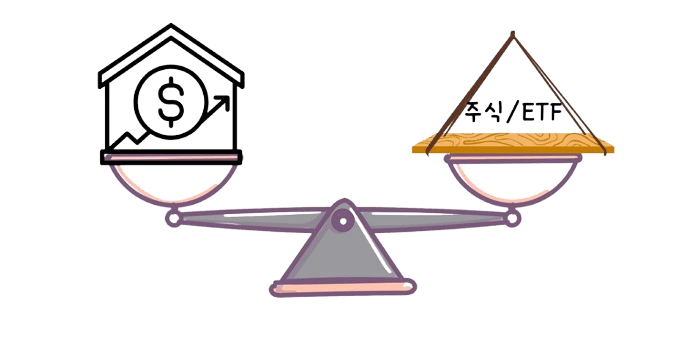
The Moment Portfolio Roles Begin to Shift
Once real estate enters a portfolio,
a large portion of capital is already committed.
As a result,
available investment funds often feel much tighter.
That’s when these questions naturally arise:
- “Should I reduce stocks now?”
- “Is it still okay to keep ETFs?”
But real estate does not make stocks and ETFs less important.
What changes is not their importance — but their role.
In this article, we’ll look at
how stocks and ETFs function after real estate enters a portfolio,
from a structural perspective.
1️⃣ Real Estate Is the Asset That “Fixes” a Portfolio
The moment real estate is added,
the portfolio inevitably changes.
- Liquidity decreases
- Adjustment speed slows
- Decisions become difficult to reverse
These are not flaws —
they are the core characteristics of real estate.
Real estate can generate returns,
but it takes time before capital flows back out.
That’s why real estate behaves less like a growth engine
and more like an asset that locks the portfolio’s shape.
👉 Related reading: [When Does Real Estate Enter a Portfolio?]
Once a fixed asset enters,
the remaining assets naturally take on a more flexible role.
2️⃣ First Role of Stocks & ETFs After Real Estate — Liquidity
Real estate cannot be converted to cash quickly.
That’s why, in a real-estate-heavy portfolio,
stocks and ETFs effectively become liquid assets.
- Adjustable in urgent situations
- Responsive to environmental changes
- A buffer within the portfolio
At this stage, stocks and ETFs shift from
“tools for higher returns”
to assets that can move when needed.
👉 Related reading: [Reducing Exchange Rate Risk Through Asset Structure]
3️⃣ Second Role — Adjusting to Environmental Change

Once real estate is in place,
it’s difficult to respond quickly to shifts in:
- Interest rates
- Exchange rates
- Economic cycles
Stocks and ETFs, however, allow adjustments through:
- Allocation
- Geography
- Asset type
Examples:
- Rising interest rates → defensive assets
- Exchange rate volatility → global assets
- Economic slowdown → volatility control
Here, stocks and ETFs become strategic assets.
👉 Related reading: [How Money Flows When Interest Rates Change]
4️⃣ The Real Question Is Not “Reduce or Not,” but “How to Hold”
After buying real estate, the key question is not:
“Should I reduce stocks?”
It becomes:
“What role should stocks now play?”
At this point, stocks and ETFs naturally shift:
- From aggressive assets → to balancing assets
- Lower short-term return expectations
- Higher structural stability
- Greater diversification and adjustability
5️⃣ Why Stocks & ETFs Are Still Essential After Real Estate
A portfolio built only on real estate
is structurally incomplete.
- Real estate → fixed
- Stocks & ETFs → adjustable
- Cash → buffering
Only when all three coexist
can a portfolio stay resilient and adaptive.
👉 Related reading: [How Exchange Rates Change Asset Value — A Beginner-Friendly Guide to Understanding Currency Impact]
That’s why maintaining stocks and ETFs after buying real estate
is not about chasing returns —
it’s about preserving optionality.
📌 Final Thoughts — Assets Are Not Reduced, Their Roles Change
Buying real estate does not mean abandoning stocks and ETFs.
Their role simply shifts
from growth-focused
to adjustment and balance-focused.
As a portfolio matures:
- Asset changes become less frequent
- Role clarity becomes more important
Investment strategy after real estate
is not about becoming more aggressive —
it’s about becoming more precise.
1 thought on “How Should Stock & ETF Strategy Change After Buying Real Estate?”
Comments are closed.