

Lately, whenever I go grocery shopping, I’ve noticed something interesting.
Even when I buy almost the same items as before,
the total at the checkout feels noticeably higher.
Products that I used to place in my cart without much thought now make me stop and look at the price tag twice.
Sometimes I even find myself wondering:
“How did it cost this much when I bought almost the same things?”
This isn’t just a personal feeling.
Across South Korea, the United States, and Europe, inflation pressures have remained elevated in recent years.
The bigger issue is that inflation doesn’t simply increase living expenses.
It gradually changes the value of money itself.
That’s why in this article, we’ll look at:
- why prices keep rising
- why cash loses purchasing power
- why more people become interested in investing
- which assets tend to perform better during inflation
in a simple and practical way.
1️⃣ Inflation Means Your Money Buys Less
When prices rise, it doesn’t simply mean products become more expensive.
The more important reality is:
👉 the same amount of money buys fewer goods and services.
For example, something that cost ₩10,000 a few years ago might now cost:
- ₩12,000
- ₩15,000
- or even more
As a result, the purchasing power of your cash decreases.
This is why inflation matters.
If inflation continues for long periods, simply saving money may no longer be enough to preserve wealth.
2️⃣ Why Do Prices Keep Rising?
Inflation can happen for many reasons.
Common causes include:
- rising commodity prices
- higher energy costs
- wage growth
- increasing money supply
After the COVID-19 pandemic, many countries injected large amounts of money into their economies.
At the same time, global supply chains experienced disruptions, creating additional price pressures.
More recently, factors such as:
- geopolitical conflicts
- oil price volatility
- global supply concerns
have continued to influence inflation expectations.
In other words:
👉 inflation is not simply a temporary event.
It is often connected to broader global economic forces.
👉 Related reading: What Assets Perform Best During a Recession? — Understanding Defensive Investing During Economic Slowdowns
3️⃣ Why Does Inflation Push People Toward Investing?
This is where investing becomes important.
As inflation rises, many people begin asking:
“If my cash keeps losing value, should I be doing something else?”
Historically, inflationary periods often encourage investors to move beyond savings accounts and look toward assets that have the potential to grow over time.
The reason is simple:
👉 some assets can increase in value alongside inflation.
Examples often include:
- stocks
- real estate
- gold
- dollar-denominated assets
Of course, no investment rises all the time.
However, over long periods, many investors prefer owning productive assets rather than holding only cash.
👉 Related reading: When Does Compound Interest Really Start Working? — A Simple Comparison of 10-Year vs 20-Year Investing
4️⃣ Which Assets Tend to Perform Better During Inflation?
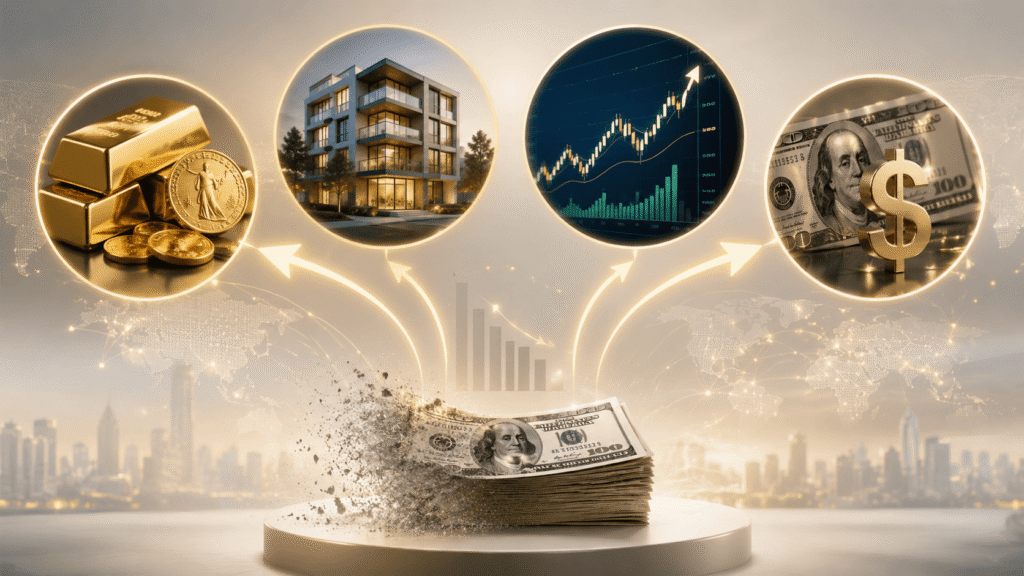
During inflationary periods, investors often become more interested in assets connected to real-world value.
Examples include:
Gold
Often viewed as a store of value during periods of monetary uncertainty.
Real Estate
A tangible asset that may benefit from rising property values and rents.
Stocks
Many companies can increase prices when costs rise, helping protect earnings over time.
Dollar Assets
The US dollar often remains an important defensive asset during periods of global uncertainty.
One key difference is that cash itself generally does not grow with inflation.
If inflation rises faster than the return on cash, purchasing power gradually declines.
That’s why inflation shifts attention toward asset allocation rather than simply accumulating cash balances.
👉 Related reading: How Much USD Assets Should You Hold? — A Practical Portfolio Allocation Strategy
5️⃣ The Most Important Goal Is Building a Sustainable Structure
When people hear about inflation, they sometimes assume they must invest aggressively.
But investing aggressively and investing wisely are not the same thing.
Markets can still experience significant volatility due to:
- interest-rate changes
- economic slowdowns
- geopolitical risks
- financial market uncertainty
That’s why long-term investing is usually less about chasing maximum returns and more about creating a structure that can survive different market environments.
Many investors focus on balancing:
- cash reserves
- investment assets
- dollar exposure
- long-term growth assets
The goal is not simply to make more money.
It is also to preserve purchasing power over time.
👉 Related reading: What Happens When Cash Allocation Increases? The Beginning of Portfolio Stability and Capital Flow Changes
📌 Final Thoughts
Inflation is about much more than higher grocery bills.
It reflects a gradual decline in the purchasing power of money.
As inflation continues, relying solely on savings may make it harder to preserve wealth over the long term.
That’s why more people become interested in investing and asset allocation.
However, the key lesson is not:
“Invest in everything.”
Instead, it is:
👉 build a portfolio structure that can protect and grow wealth across different economic environments.
Because in long-term investing, preserving the value of your money can be just as important as generating returns.
1 thought on “Why Inflation Makes Investing More Important — Understanding the Declining Value of Cash”
Comments are closed.