

When I first started following economic news,
whenever I heard phrases like:
“recession risks are rising”
I mostly understood it as:
👉 “the stock market may fall.”
But after watching market behavior more closely over time,
I realized the situation is much more complicated than that.
During recession fears:
- stock markets become volatile
- investors become uncertain
- people begin asking: “Is it still safe to invest right now?”
But one important thing becomes very clear:
👉 not all assets move the same way during economic downturns.
Some assets perform well when the economy is strong,
while others tend to hold up better during recessions.
So in this article, we’ll look at:
- why markets become unstable during recessions
- which assets tend to perform relatively well
- why investors shift toward certain assets during downturns
in a simple and practical way.
1️⃣ Why Do Markets Become Unstable During Recessions?
A recession can be understood simply as:
👉 a slowdown in the flow of money throughout the economy.
People begin reducing spending,
while companies slow down:
- hiring
- investment
- expansion plans
As a result, investors begin worrying about weaker corporate earnings.
And because markets try to price in the future early,
investors react quickly when they see signals such as:
- slowing consumer spending
- weaker profit expectations
- rising unemployment risks
At that point, investors often reduce exposure to risk assets first.
That’s why recessions usually bring:
👉 higher market volatility.
👉 Related reading: Why Strong US Job Data Can Push the S&P 500 Higher
2️⃣ Which Assets Do Investors Usually Seek First During Recessions?
When uncertainty increases,
investors naturally begin searching for:
👉 safer assets.
Common examples include:
- the US dollar
- gold
- US Treasury bonds
- cash
These assets are often viewed as safer because they tend to offer:
- lower volatility
- stronger trust during crises
- higher liquidity
For example, the US dollar remains the center of the global financial system.
So during market stress,
capital often flows toward dollar-based assets.
Gold also tends to attract attention during uncertain periods because it has historically served as:
- a store of value
- a defensive asset
- a crisis hedge
👉 Related reading: Why Foreign Exchange Crises Happen — Dollar Shortages, Exchange Rates, and Financial Market Panic
3️⃣ Why Do Defensive Assets Become Stronger During Recessions?
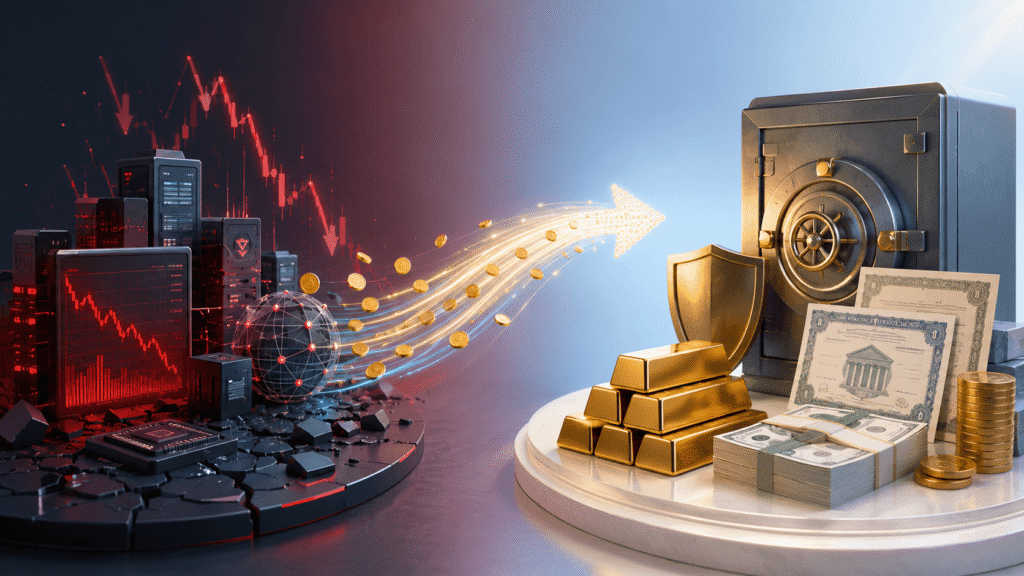
The key is:
👉 the flow of money.
As risk increases, investors begin prioritizing:
- stability
- liquidity
- protection
over aggressive growth.
For example, technology growth stocks often depend heavily on:
- future expectations
- long-term expansion
- strong economic growth
So when recession fears increase,
those expectations may weaken quickly.
Meanwhile, assets connected to:
- stable cash flow
- government trust
- financial safety
often become relatively more attractive.
That’s why recession environments often create patterns like:
- weaker growth stocks
- stronger defensive assets
In other words:
👉 markets begin shifting away from risk and toward stability.
👉 Related reading: Growth Stocks vs Value Stocks — How Interest Rates Change Market Leadership
4️⃣ Does That Mean Investors Should Avoid Stocks Completely?
When recession fears appear, many people think:
“Should I just sell all my stocks?”
But markets are rarely that simple.
In fact:
👉 stock markets often move before the economy itself improves.
Sometimes, by the time economic conditions feel worst in real life,
markets may already be preparing for recovery.
That’s why investing during recessions is not simply about reacting to fear.
Instead, it becomes more about:
👉 building a plan that can survive uncertainty.
For example:
- adjusting cash allocations
- diversifying into dollar assets
- maintaining a long-term investment strategy
can often be more realistic approaches than trying to perfectly time the market.
👉 Related reading: What Happens When Cash Allocation Increases? The Beginning of Portfolio Stability and Capital Flow Changes
5️⃣ The Most Important Thing Is Building a Structure You Can Survive
During recessions, market volatility usually increases significantly.
That’s why investing becomes less about maximizing returns—
👉 and more about building a structure you can endure.
If investors react emotionally every time markets fall,
it becomes very difficult to maintain long-term strategies.
So the real question is not only:
“Which asset should I own?”
but also:
👉 “Can my portfolio survive difficult markets?”
In many cases, the investors who survive downturns consistently
end up producing stronger long-term results.
👉 Related reading: Dollar-Cost Averaging vs Lump-Sum Investing — Returns vs Risk Explained
📌 Final Thoughts
When recessions begin, market sentiment changes quickly.
During these periods, investors often move toward assets such as:
- dollars
- gold
- bonds
- cash
in order to reduce risk.
But more important than identifying:
“Which asset is strongest?”
is understanding:
👉 why money is moving in that direction.
Because in investing,
surviving difficult periods is often just as important as generating high returns.
And long-term success usually comes from:
👉 building a portfolio structure that can withstand uncertainty.
1 thought on “What Assets Perform Best During a Recession? — Understanding Defensive Investing During Economic Slowdowns”
Comments are closed.