

Once you decide which ETF to invest in,
the next question naturally comes up:
👉 Should you invest all at once?
👉 Or invest gradually over time?
This is not just a difference in method.
It directly affects:
- returns
- risk
- emotional stability
So instead of asking which one is better,
this article focuses on:
👉 Which strategy fits which situation
1️⃣ The Core Difference Between the Two Strategies
Let’s simplify it first.
✔ Dollar-Cost Averaging (DCA)
- Invest a fixed amount regularly
- Example: investing every month
👉 “Spreading investment over time”
✔ Lump-Sum Investing
- Invest all available capital at once
👉 “Concentrating on timing”
So structurally:
- DCA → reduces timing risk
- Lump sum → maximizes market exposure
👉 DCA = risk distribution
👉 Lump sum = full exposure
👉 Related reading: How to Start Investing in Global ETFs — A Beginner Portfolio Guide
2️⃣ Which One Has Higher Returns?
Historically,
lump-sum investing often produces higher returns.
Why?
Because markets tend to rise over time.
👉 The earlier you invest,
👉 the longer your money stays in the market.
But there’s a critical condition:
👉 Timing matters
If you invest a large amount near a market peak:
- you may experience significant short-term losses
- recovery may take time
On the other hand, DCA:
- buys less when prices are high
- buys more when prices are low
This naturally smooths out volatility.
👉 Lump sum → higher potential return
👉 DCA → lower risk and smoother experience
👉 Related reading: Why Portfolio Rebalancing Matters — When, How Much, and What to Adjust
3️⃣ When DCA Is the Better Choice
DCA is more suitable if:
- you are a beginner
- you feel uncertain about timing
- you invest using monthly income
- you want to reduce emotional stress
A key advantage:
👉 psychological stability
Instead of asking:
- “Is this the right time?”
You follow a simple rule:
👉 “I invest consistently.”
This reduces hesitation
and prevents missed opportunities.
DCA works best when:
- income is regular
- market direction is unclear
- consistency matters more than precision
👉 DCA = sustainable investing structure
👉 Related reading: How Should You Split ETFs in an Uncertain Market? — An ETF Strategy Based on “Roles,” Not Products
4️⃣ When Lump-Sum Investing Makes More Sense
Lump-sum investing becomes powerful
under certain conditions.
It works best when:
- markets have already declined significantly
- long-term upward trend is expected
- you have a large amount of capital
- you can stay invested for a long time
Why?
Because markets often rise quickly
in short bursts.
If your capital is not invested during that period,
you may miss a large part of the gains.
Important clarification:
👉 Lump sum is NOT about perfect timing
It is about:
👉 staying invested during favorable conditions
The goal is not:
- to catch the exact bottom
But:
- to enter at a reasonable level
- and remain invested long enough
👉 Lump sum = time in the market advantage
👉 Related reading: What Happens When Cash Allocation Increases? The Beginning of Portfolio Stability and Capital Flow Changes
5️⃣ The Most Practical Strategy — Combine Both
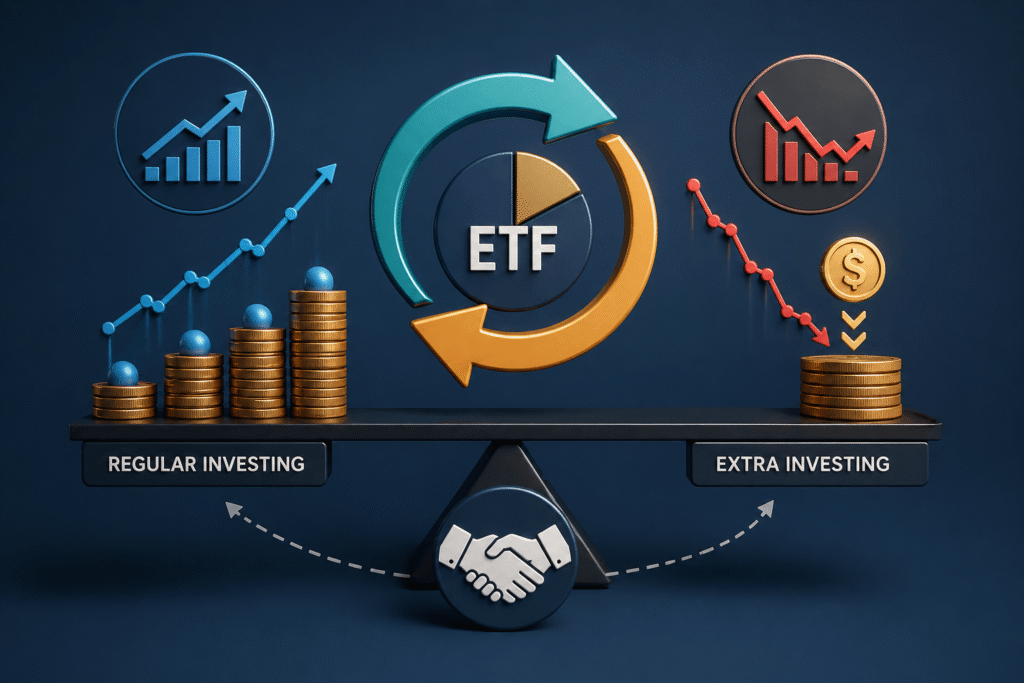
In reality,
the best approach is often a combination.
A practical structure:
- invest regularly (DCA)
- add extra investment during market declines
This allows you to:
- benefit from long-term growth
- take advantage of downturn opportunities
- reduce timing pressure
Example:
- monthly DCA → consistent exposure
- market dip → additional lump-sum investment
👉 DCA + opportunistic lump sum = balanced strategy
📌 Final Thoughts
Dollar-cost averaging and lump-sum investing
are not competing strategies.
They serve different purposes.
- DCA → stability and consistency
- Lump sum → efficiency and growth
The best strategy is not choosing one.
👉 It is knowing when to use each.
Investing is not about finding a perfect answer.
👉 It’s about building a structure that fits your situation.
1 thought on “Dollar-Cost Averaging vs Lump-Sum Investing — Returns vs Risk Explained”
Comments are closed.