

When people try to start global investing,
they often get stuck at an unexpected point.
It’s not about understanding which assets are good.
It’s about not knowing how to actually begin.
Concepts like:
- ETFs
- stocks
- exchange rates
may make sense individually,
but they don’t always connect into real action.
In this situation,
looking for more information is not the solution.
👉 The key is to build a structure that allows you to start.
In this article,
instead of long explanations,
we’ll focus on the most practical way
to begin investing in global ETFs.
1️⃣ ETFs Mean “Owning the Whole Market at Once”
You don’t need to overcomplicate ETFs.
An ETF is not an investment in one company.
It’s a structure that lets you invest in
many companies at once.
For example:
- An S&P 500 ETF invests in 500 major US companies simultaneously
The advantage is simple:
- you are not dependent on a single company
- your risk is naturally diversified
- you follow the overall market trend
This makes ETFs especially suitable for beginners
who don’t want to analyze individual stocks.
When I first started,
I also didn’t have strong conviction about individual companies.
So I built my portfolio around:
- S&P 500
- Nasdaq 100
For beginners,
starting with ETFs instead of individual stocks
is a more stable and sustainable approach.
👉 Related reading: How Much USD Assets Should You Hold? — A Practical Portfolio Allocation Strategy
2️⃣ The Most Common Mistakes Beginners Make
When starting ETF investing,
there are two major pitfalls.
❌ Trying to hold too many ETFs
As you read more,
you may think:
“I need more diversification.”
This often leads to buying too many ETFs at once.
But in reality:
- many ETFs overlap
- roles become unclear
- portfolio management becomes harder
I experienced this myself early on.
Adding more ETFs didn’t improve results.
It just made decisions more confusing.
👉 The key is not quantity.
👉 It’s clarity of structure.
❌ Overthinking timing
Many beginners hesitate because they ask:
- “Is now the right time?”
- “What about exchange rates?”
This often delays investing indefinitely.
But in ETF investing:
👉 structure matters more than timing
Building a system you can follow consistently
is far more important than predicting the market.
👉 Related reading: Investment Strategy in a Weak Currency Era — How Exchange Rates Impact Assets and What to Do
3️⃣ Keep the Starting Process Simple
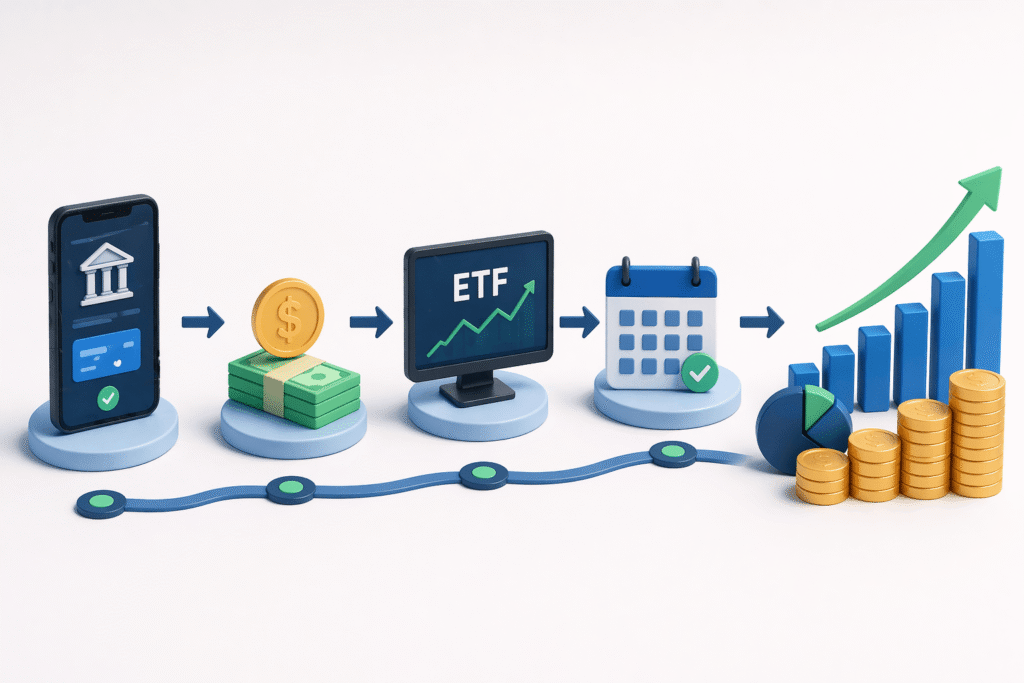
Starting global investing does not require complexity.
A simple approach:
- Open an account that allows international investing
- Start with a small amount
- Focus on getting used to the process
Starting small is important.
It reduces pressure
and helps you learn through experience.
After that,
the most effective method is:
👉 investing a fixed amount regularly
This creates:
- consistency
- average cost over time
- reduced emotional decisions
The goal is not to be perfect from the beginning.
👉 The goal is to build something you can continue.
👉 Related reading: If You Invest $100,000 in ETFs — What Could It Become in 10 Years?
4️⃣ The Simplest Beginner Portfolio
When building your first portfolio,
simplicity is your strongest advantage.
A widely used structure is:
- S&P 500 ETF
- Nasdaq 100 ETF
Why this works:
- S&P 500 → broad market exposure
- Nasdaq → growth and technology exposure
Together, they provide:
- stability
- growth potential
Instead of adding many assets from the start,
it’s better to:
👉 master this structure first
👉 then expand gradually
👉 Related reading: Why Portfolio Rebalancing Matters — When, How Much, and What to Adjust
5️⃣ The Most Realistic Strategy Is Consistency
ETF investing is not complicated.
The real challenge is not prediction.
It is consistency.
Markets move in the short term,
but tend to grow over the long term.
So the key actions are:
- invest regularly
- adjust when allocation shifts too much
- stay in the market
If you maintain this structure:
- you avoid emotional reactions
- you capture long-term growth
- you build discipline
Consistency beats timing.
📌 Final Thoughts
Global ETF investing does not need to be complex.
In fact,
starting with a simple structure
and maintaining it over time
is far more important.
Instead of searching for the perfect answer:
👉 start with something manageable
👉 build a system you can continue
Investing is not about knowing everything.
👉 It’s about creating a structure you can sustain.
2 thoughts on “How to Start Investing in Global ETFs — A Beginner Portfolio Guide”
Comments are closed.