
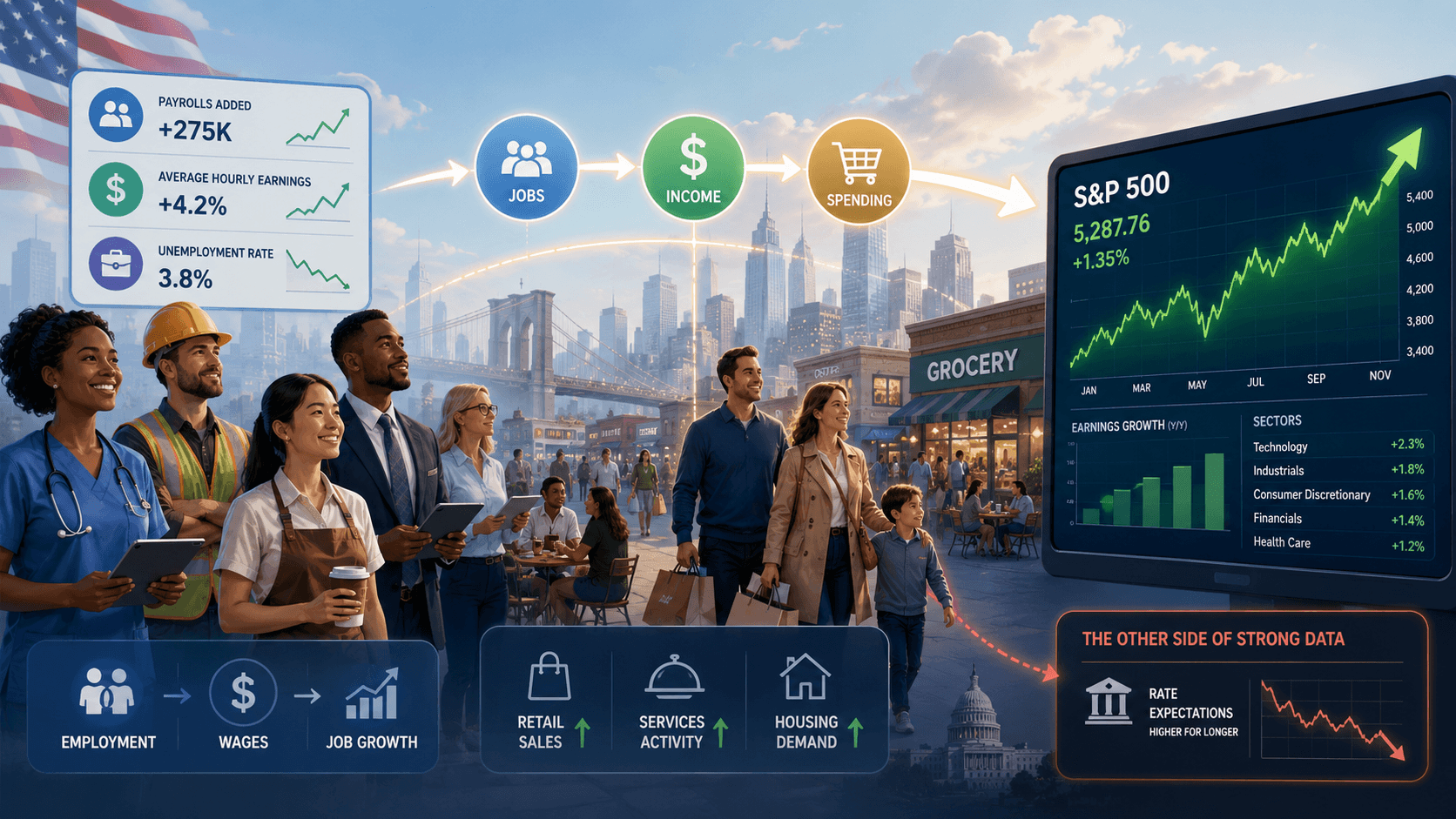
When reading economic news,
you often see headlines like this:
“The S&P 500 rises after stronger-than-expected US jobs data.”
At first, this can feel a little confusing.
Why would job numbers affect the stock market?
But in reality,
the US labor market and the stock market are deeply connected.
Because the labor market is not just about employment numbers.
👉 It represents the entire structure of how people earn money and spend money.
So in this article, we’ll look at:
- why employment data matters
- how the labor market connects to the S&P 500
- why stocks sometimes fall even when job data is strong
in a simple and practical way.
1️⃣ Employment Data Shows the “Strength of the Economy”
US employment data basically shows:
👉 how many people are working and earning income.
It includes indicators such as:
- unemployment rate
- nonfarm payroll growth
- wage growth
These numbers matter because:
- people need jobs to earn money
- people need money to spend
For example:
- if more people are employed
- wages continue rising
- consumers keep spending
then companies can sell more products and services.
In other words:
👉 a strong labor market usually means money is still flowing through the economy.
2️⃣ Why Does Higher Consumer Spending Push Stocks Up?
The stock market reflects expectations about future corporate profits.
If investors believe companies will earn more money in the future,
they begin valuing those companies more highly.
And the US economy is especially dependent on consumer spending.
That means:
👉 consumers must continue spending for businesses to grow.
So when the labor market improves, the following chain often happens:
employment growth
→ stronger consumer spending
→ higher company revenue
→ stronger earnings expectations
→ stock market gains
This is why US employment reports directly influence the S&P 500.
👉 Related reading: Why Interest Rates Move All Assets — The Most Important Investment Factor
3️⃣ Why Is the S&P 500 Mentioned So Often?
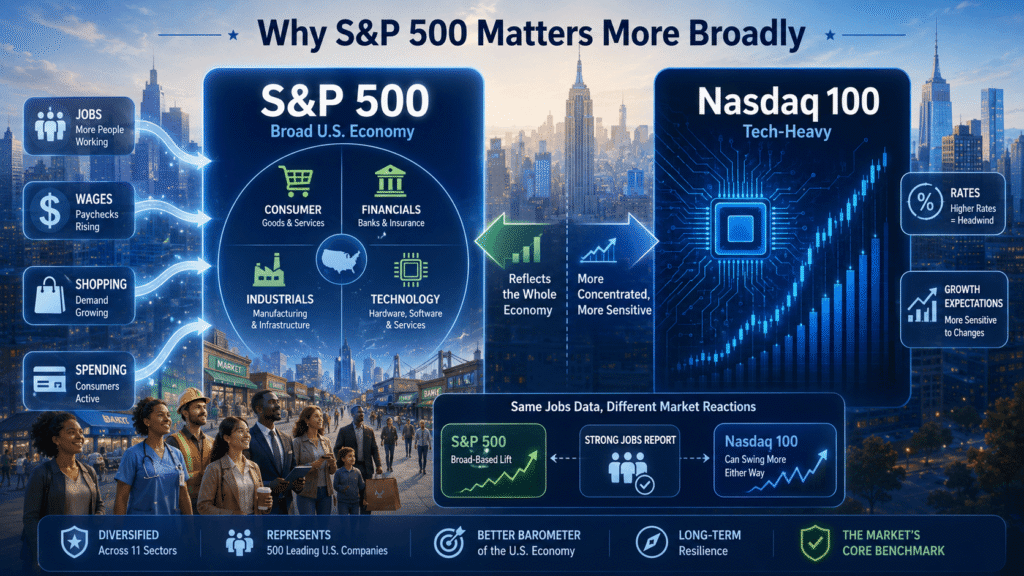
The S&P 500 is frequently mentioned because it tracks 500 of America’s largest companies.
That means it reflects:
👉 the broader US economy, not just one industry.
It includes companies from sectors like:
- consumer goods
- finance
- industrials
- technology
So if employment and consumer activity improve,
many sectors inside the index can benefit simultaneously.
The Nasdaq 100, however, behaves somewhat differently.
Because it is heavily weighted toward technology companies,
it reacts more strongly to:
- interest rates
- growth expectations
- tech sector sentiment
That’s why the same employment report can sometimes affect:
- the S&P 500
- the Nasdaq 100
in different ways.
4️⃣ Then Why Do Stocks Sometimes Fall Even When Job Data Is Strong?
This is where many investors become confused.
I also remember wondering:
“If the economy is doing well, why are stocks falling?”
This usually happens when markets begin worrying more about interest rates.
If the labor market becomes “too strong,” markets may fear:
- higher consumer spending
- faster wage growth
- rising inflation pressure
And if inflation risks increase,
the Federal Reserve may keep interest rates higher for longer.
That creates new concerns:
- higher borrowing costs for companies
- slower future spending
- pressure on growth stocks
So sometimes markets react like this:
👉 “Strong economy = positive for stocks”
But other times they react like this:
👉 “The economy is too strong → rates may stay high → negative for stocks”
That’s why stock markets do not always move in the same direction after strong employment reports.
👉 Related reading: Why Foreign Exchange Crises Happen — Dollar Shortages, Exchange Rates, and Financial Market Panic
5️⃣ In the End, Markets Follow the Flow of Money
Stock markets do not move based on headlines alone.
Markets constantly try to answer one question:
👉 “Where will money flow next?”
That’s why employment data is interpreted alongside:
- consumer spending
- corporate earnings
- interest rates
- market liquidity
Once you begin understanding this structure,
economic news stops feeling random.
Instead, you start seeing:
👉 how money moves through the system.
👉 Related reading: S&P 500 vs Nasdaq ETF — How to Choose Based on Your Investment Style
📌 Final Thoughts
US employment data is not just about job numbers.
Inside those reports are signals about:
- consumer activity
- corporate earnings
- interest rate direction
- market sentiment
That’s why stronger labor markets often support indexes like the S&P 500.
But markets are always balancing two forces:
- economic growth
- interest rate pressure
And that’s why understanding the flow of money matters more than simply reading headlines.
Because in investing,
markets react not just to what is happening now—
👉 but to what investors believe will happen next.
2 thoughts on “Why Does the Stock Market Rise When US Job Data Is Strong? — A Simple Explanation of S&P 500 Reactions”
Comments are closed.