

When you start investing in global ETFs,
you quickly face one key decision:
👉 S&P 500 or Nasdaq?
Both are among the most widely used ETFs
for investing in the US market.
They have both delivered long-term growth,
and many investors use them as core assets.
But here’s the important point:
👉 These are not “similar ETFs.”
👉 They are fundamentally different in structure.
If you don’t understand this difference,
you may lose direction when markets become volatile.
So instead of asking:
“Which one is better?”
This article focuses on:
👉 How to choose based on your investment style
1️⃣ Why Are S&P 500 and Nasdaq Always Compared?
The reason is simple.
Both represent the US market,
but in very different ways.
✔ S&P 500
- 500 major US companies
- Includes finance, healthcare, consumer goods, industry
- Reflects the overall US economy
✔ Nasdaq (Nasdaq 100)
- Focused on technology companies
- High weight in Apple, Microsoft, Nvidia, etc.
- Driven by growth and innovation
So structurally:
👉 S&P 500 = broad market exposure
👉 Nasdaq = growth-focused exposure
Understanding this difference
is the foundation of your decision.
👉 Related reading: How to Start Investing in Global ETFs — A Beginner Portfolio Guide
2️⃣ Why Do Their Returns Differ?
The biggest difference shows up in performance.
✔ Nasdaq
- Higher growth potential
- Outperforms during bull markets
- Driven by tech leadership
✔ But also:
- higher volatility
- sharper drawdowns in downturns
- sensitive to interest rates
✔ S&P 500
- More balanced across sectors
- less dependent on one industry
- smoother and more stable performance
So the real question is not:
👉 “Which has higher returns?”
It is:
👉 “What level of volatility can you handle?”
👉 Related reading: Why Interest Rates Move All Assets — The Most Important Investment Factor
3️⃣ When S&P 500 Is More Suitable
S&P 500 is better suited if you:
- prefer stability
- are new to investing
- want steady long-term growth
- are sensitive to volatility
Because it tracks the entire market,
it works well as a core portfolio asset.
It also pairs well with:
- cash holdings
- conservative portfolio structures
👉 S&P 500 = foundation asset
👉 Related reading: What Happens When Cash Allocation Increases? The Beginning of Portfolio Stability and Capital Flow Changes
4️⃣ When Nasdaq Is More Suitable
Nasdaq is more suitable if you:
- seek higher returns
- believe in long-term tech growth
- can tolerate volatility
- are focused on growth industries
However, this comes with trade-offs:
- larger price swings
- deeper corrections during downturns
Because of this,
Nasdaq is often better used as:
👉 a partial allocation, not a full portfolio
👉 Nasdaq = growth accelerator
5️⃣ The Most Realistic Strategy — Combine Both
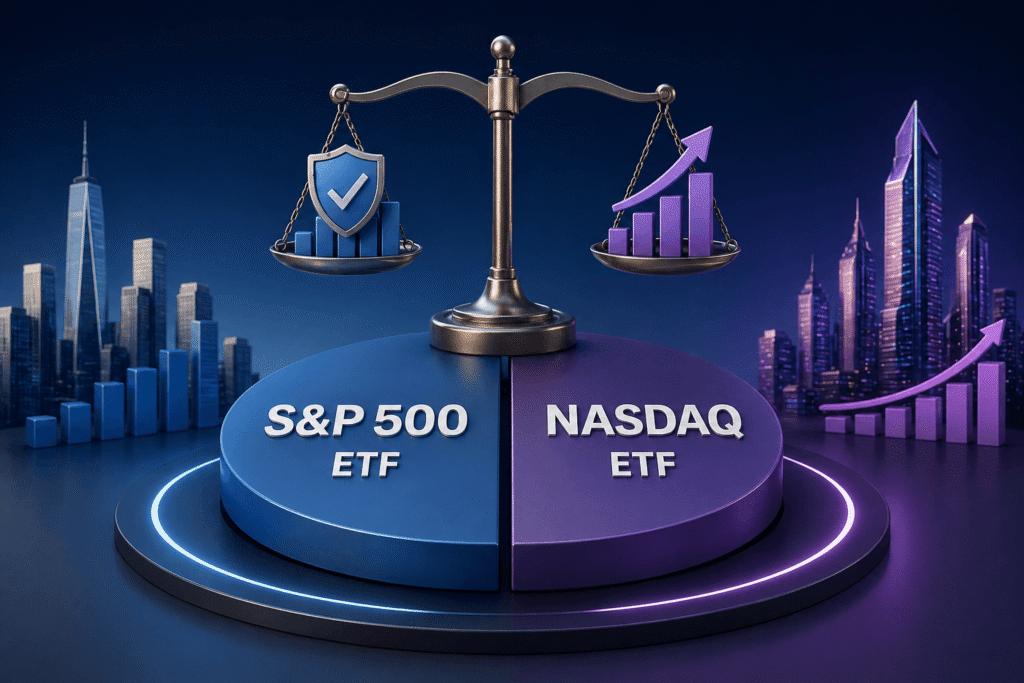
S&P 500 and Nasdaq are not competitors.
👉 They are complementary assets.
A combined structure provides:
- stability + growth
- diversification + concentration
A common approach:
- S&P 500 as the core
- Nasdaq as a growth component
For example:
👉 S&P 500 70%
👉 Nasdaq 30%
This structure is widely used
in long-term portfolios.
It allows you to:
- reduce risk
- capture growth opportunities
- stay invested consistently
👉 Related reading: Why Portfolio Rebalancing Matters — When, How Much, and What to Adjust
📌 Final Thoughts
Both S&P 500 and Nasdaq are strong assets.
But the real question is not:
👉 “Which is better?”
It is:
👉 “Which fits your strategy?”
- Want stability → S&P 500
- Want growth → Nasdaq
- Want balance → combine both
Investing is not about picking winners.
👉 It’s about building a structure that fits you.
1 thought on “S&P 500 vs Nasdaq ETF — How to Choose Based on Your Investment Style”
Comments are closed.