

When looking at the stock market,
some companies attract attention because they appear undervalued compared to:
- their current earnings
- their assets
- their business stability
This is where the concepts of:
👉 growth stocks and value stocks
begin to appear.
In financial news, you often hear phrases like:
- “Growth stocks are leading the market”
- “Money is rotating into value stocks”
- “Higher interest rates are hurting growth stocks”
At first, these terms can feel abstract and confusing.
But in reality,
understanding growth stocks and value stocks is deeply connected to understanding:
👉 how markets move.
So in this article, we’ll look at:
- the difference between growth stocks and value stocks
- why interest rates matter so much
- when each type of stock tends to perform better
in a simple and practical way.
1️⃣ Growth Stocks Move on “Future Expectations”
Growth stocks are companies where:
👉 future expansion matters more than current size.
They are often found in industries such as:
- artificial intelligence
- semiconductors
- platforms
- technology
Companies like Nvidia or Tesla are good examples.
Investors care not only about what these companies earn today,
but more importantly:
“How much bigger could this company become in the future?”
Because of this, growth stocks often rise rapidly when future expectations increase.
But the opposite is also true.
If future expectations weaken,
growth stocks can become highly volatile.
In other words:
👉 growth stocks are heavily influenced by future potential.
👉 Related reading: Why the Nasdaq Rises When Interest Rates Fall — Growth Stocks and Interest Rates Explained
2️⃣ Value Stocks Focus More on “Current Strength”
Value stocks are different.
They are companies where:
👉 current earnings and stability matter more.
Examples often include industries such as:
- banking
- energy
- telecommunications
- traditional industrial businesses
These companies may not grow explosively,
but they often generate:
- stable cash flow
- consistent earnings
- reliable business performance
That’s why value stocks are usually evaluated based on questions like:
- Is the company already making solid profits?
- Is the stock price relatively cheap compared to earnings or assets?
So while growth stocks focus on future possibilities,
👉 value stocks focus more on current stability.
3️⃣ Why Do Growth Stocks Struggle When Interest Rates Rise?
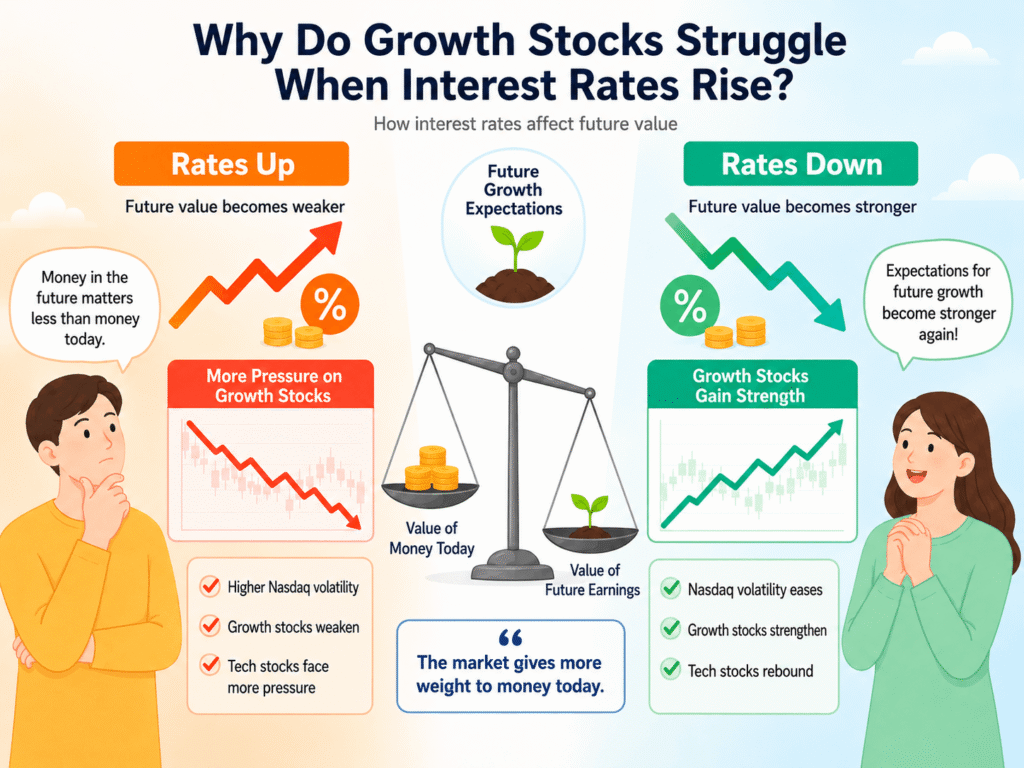
This is where interest rates become extremely important.
Growth stocks depend heavily on future expectations.
But when interest rates rise:
👉 future profits become less valuable in today’s terms.
A simple way to think about it is this:
“Money earned today becomes more valuable than money expected far in the future.”
As a result, companies valued mostly on future growth begin facing pressure.
This is why rising rates often lead to:
- higher Nasdaq volatility
- weaker growth stocks
- pressure on technology shares
On the other hand, when rates fall:
👉 future growth expectations become more valuable again,
which often supports growth stocks.
👉 Related reading: Why Interest Rates Move All Assets — The Most Important Investment Factor
4️⃣ When Do Value Stocks Become Stronger?
Value stocks often perform relatively well when:
- interest rates are high
- market uncertainty increases
This happens because investors begin prioritizing:
👉 current stability over future expectations.
For example, during economic slowdowns, investors often move toward companies with:
- stable earnings
- strong cash flow
- resilient business models
That’s why markets often rotate between:
- growth-stock leadership
- value-stock leadership
depending on economic conditions.
5️⃣ In the End, Balance Matters Most
Many investors eventually ask:
- “Are growth stocks better?”
- “Are value stocks safer?”
But in reality, markets rarely favor one side forever.
Different market environments create periods where:
- growth stocks outperform
- value stocks outperform
over and over again.
That’s why long-term investing often works better when portfolios include both:
👉 growth potential and stability.
For example:
- the S&P 500 contains a relatively balanced mix
- the Nasdaq 100 has much heavier growth-stock exposure
Thinking about them this way makes the structure much easier to understand.
👉 Related reading: S&P 500 vs Nasdaq ETF — How to Choose Based on Your Investment Style
📌 Final Thoughts
The biggest difference between growth stocks and value stocks is simple:
👉 Growth stocks = future expectations
👉 Value stocks = current stability
And interest rates strongly influence which side the market prefers.
That’s why investing is not about deciding:
“Which type is always better?”
Instead, the real question is:
👉 “What is the market prioritizing right now?”
Because markets constantly move between:
- future optimism
- present stability
and understanding that balance is one of the most important parts of investing.
1 thought on “Growth Stocks vs Value Stocks — Why Interest Rates Change Market Leadership”
Comments are closed.