

In the past,
it was often enough to think about assets only in local currency terms.
But today,
even if the asset is the same,
its real value can change depending on
which currency it is held in.
This shift is becoming more visible over time.
In this environment,
USD-denominated assets are no longer optional.
They are becoming a core pillar of a portfolio.
The real question is no longer:
“Should I hold USD assets?”
It is:
👉 “How much should I hold?”
In this article,
we’ll break down a practical approach
to USD asset allocation and portfolio structure
in a way that beginners can easily understand.
1️⃣ Why USD Allocation Has Become More Important
The importance of USD assets
is not just about exchange rates.
Global capital always moves toward:
- stability
- higher returns
And in the current structure,
the United States still plays a central role.
Because of this,
the US dollar functions not just as a currency,
but as a global benchmark.
If your portfolio is entirely in local currency:
- your assets may lose relative value globally
But if you include USD assets:
- you can hedge against currency depreciation
- participate in global growth
- diversify your portfolio
👉 Related reading: Investment Strategy in a Weak Currency Era — How Exchange Rates Impact Assets and What to Do
2️⃣ A Realistic USD Allocation Range
Now comes the most important question:
👉 “What percentage is appropriate?”
There is no single correct answer.
It depends on your situation and strategy.
Here’s a practical framework:
✔ Below 10%
- Minimal currency hedge
- Experience-focused
👉 “Beginner stage”
✔ 10–30%
- Basic currency risk protection
- Partial exposure to global assets
👉 “Most realistic range”
✔ 30–50%
- Significant global allocation
- Active reflection of currency effects
👉 “Long-term investor range”
✔ 50%+
- Global-centered portfolio
- Minimal reliance on local currency
👉 “Advanced investor level”
The key is not simply adding USD assets.
👉 It’s about how they are integrated into your portfolio.
3️⃣ What Counts as USD Assets?
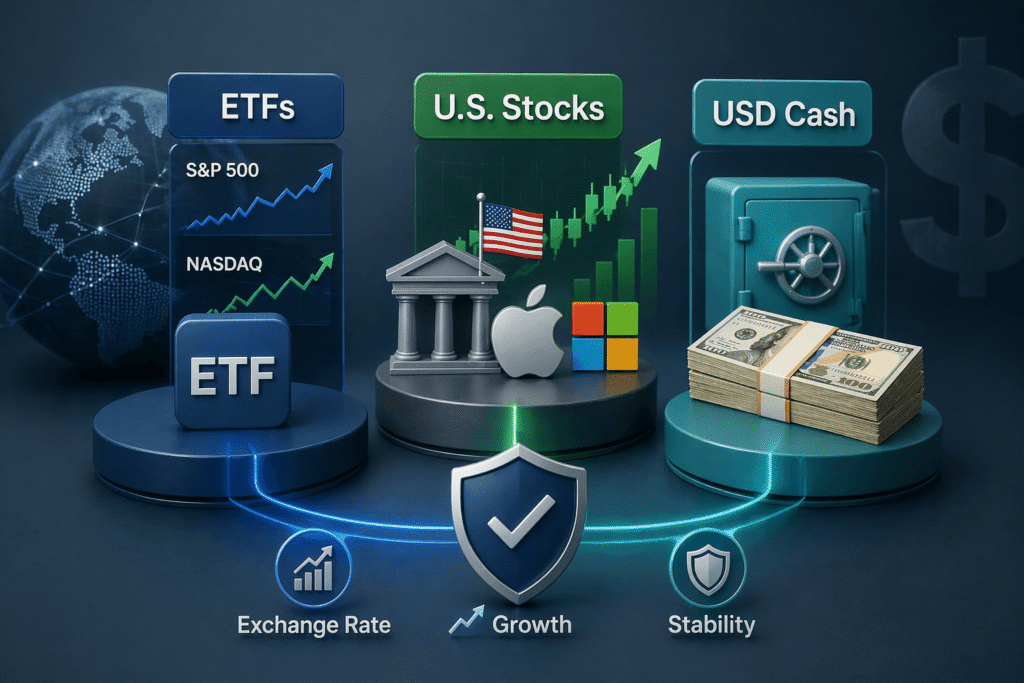
Holding USD assets does not mean
you must hold physical dollars.
The most practical way is to
gain USD exposure through investments.
Common options include:
✔ US ETFs
- S&P 500
- Nasdaq 100
- Simple and efficient
✔ US Stocks
- Individual company investments
- Growth-oriented
✔ USD Cash
- Stability-focused
- Short-term flexibility
By combining these,
you can achieve:
- currency exposure
- growth potential
- portfolio stability
👉 Related reading: What Happens When Cash Allocation Increases? The Beginning of Portfolio Stability and Capital Flow Changes
4️⃣ Common Mistakes in USD Investing
There are two major mistakes beginners often make:
❌ Going all-in
- Assuming USD will always rise
- Overconcentrating in one direction
❌ Chasing timing
- Entering after large currency moves
- Investing based on short-term expectations
Exchange rates are difficult to predict.
👉 Structure matters more than timing.
The most realistic approach is:
- gradual allocation
- consistent adjustment
5️⃣ The Most Practical Strategy
The key is not just “how much,”
but how you structure your portfolio.
A practical approach looks like this:
- combine local currency assets + USD assets
- maintain a stable allocation
- adjust gradually based on market conditions
This allows you to:
- protect assets when the currency weakens
- limit risk when the currency strengthens
- participate in global growth
👉 Related reading: Why Portfolio Rebalancing Matters — When, How Much, and What to Adjust
📌 Final Thoughts
USD assets are no longer optional.
In a world where:
- exchange rates
- capital flows
- global markets
are deeply connected,
USD assets have become a necessary pillar.
But the key is not:
👉 holding more
It is:
👉 allocating properly
Investing is not about picking assets.
It is about building a structure.
And within that structure,
USD assets play a crucial role in maintaining balance.
2 thoughts on “How Much USD Assets Should You Hold? — A Practical Portfolio Allocation Strategy”
Comments are closed.