

When you first enter the crypto market,
you almost always face the same questions:
“I’ve heard of Bitcoin and Ethereum…
but why are there so many other coins?”
- Should I buy Bitcoin?
- Should I buy Ethereum?
- Why do so many altcoins exist?
At first, everything looks similar.
But in reality, their roles and structures are completely different.
I had the same experience.
In the beginning, I thought:
👉 “Aren’t they all basically the same?”
So I bought small amounts of multiple coins.
But over time,
I realized that everything tends to converge toward Bitcoin as the core.
In this article,
we’ll break down the difference between Bitcoin and Ethereum
in a simple, beginner-friendly way.
1️⃣ Why Is Bitcoin the Market Standard?
There are thousands of cryptocurrencies.
So why do most people use Bitcoin as a reference?
The reason is simple:
👉 It came first, and it earned the most trust.
Bitcoin has:
- the first-mover advantage
- the largest user base
- the highest recognition
If we compare it to the stock market:
👉 Bitcoin acts like an index (e.g., S&P 500)
So when the market moves:
- Bitcoin rises → the whole market rises
- Bitcoin falls → the whole market falls
This pattern repeats consistently.
👉 Bitcoin is not just a coin
👉 it is the benchmark asset of the crypto market
👉 Related reading: Gold vs Bitcoin — Which Is Safer in a Crisis? (Safe-Haven Comparison & Investment Framework)
2️⃣ What Makes Bitcoin Different?
Bitcoin’s core is not just technology.
👉 It is trust structure
Bitcoin has:
- a fixed supply (21 million coins)
- no central authority
- rules that cannot be easily changed
This creates one powerful idea:
👉 “It does not change”
That’s why Bitcoin is often called:
👉 “digital gold”
From an investment perspective:
- long-term holding
- store of value
These are the dominant approaches.
I used to focus on short-term gains,
but over time, my perspective shifted toward:
👉 holding it as an asset
👉 Related reading: Why Bitcoin Gains Attention During Crises — The Dollar System and Asset Structure
3️⃣ Why Is Ethereum Different?
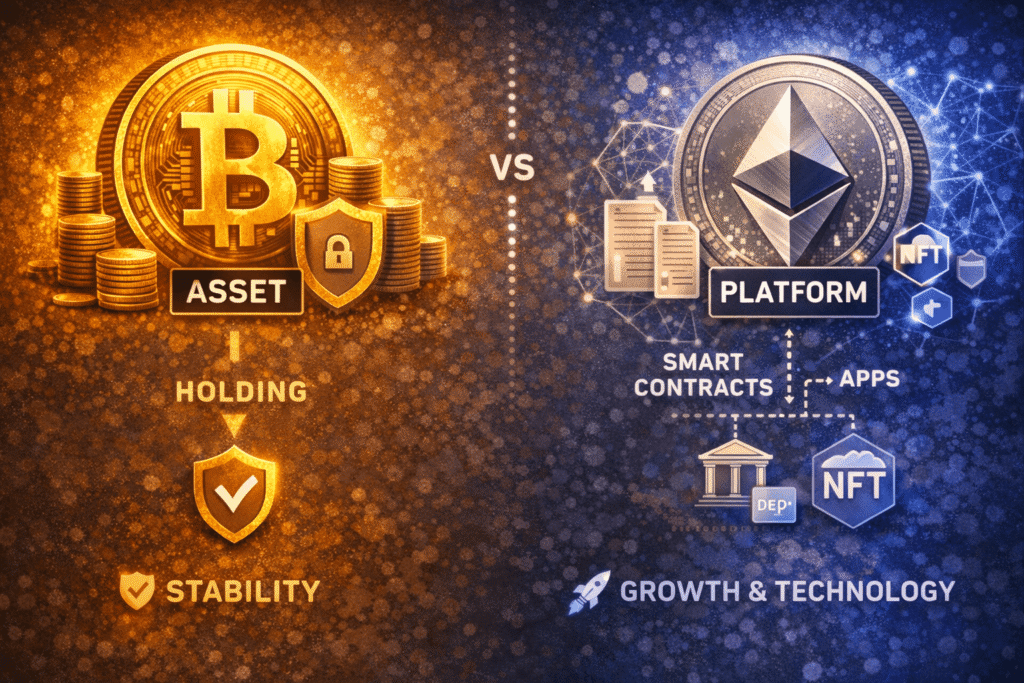
Bitcoin and Ethereum move in completely different directions.
👉 Bitcoin = asset
👉 Ethereum = platform
Ethereum enables:
- smart contracts
- decentralized applications (DeFi, NFTs)
- ecosystem building
In simple terms:
- Bitcoin = store of value
- Ethereum = usage and expansion
This leads to different investment perspectives:
- Bitcoin → stability-oriented
- Ethereum → growth + technology-oriented
If you don’t understand this difference,
your strategy can easily become unstable.
4️⃣ Why Do Most Altcoins Disappear?
This is the most realistic part.
There are thousands of altcoins,
but most disappear over time.
The reasons are:
- lack of differentiation
- lack of trust
- inability to survive in the market
Beginners often choose altcoins because:
- “They are cheap”
- “They might go up a lot”
I made the same mistake early on.
I spread my investments across many coins,
but eventually consolidated back into Bitcoin.
👉 Related reading: Why Portfolio Rebalancing Matters — When, How Much, and What to Adjust
5️⃣ How Should You Invest?
The most important question is:
👉 “So what should I actually buy?”
There’s no single correct answer,
but there is a clear structure.
✔ For beginners:
- Bitcoin as the core
- Ethereum as a secondary position
- limited exposure to altcoins
This is the most stable approach.
✔ Core framework:
- Bitcoin → benchmark asset
- Ethereum → growth asset
- Altcoins → high-risk assets
Understanding these roles
is critical for long-term investing.
📌 Final Thoughts
Bitcoin and Ethereum are not competitors.
👉 They serve different roles.
- Bitcoin → benchmark + store of value
- Ethereum → technology + expansion
So the key is not:
👉 “Which one is better?”
But:
👉 “How do you use each one?”
The crypto market changes rapidly.
But if you understand the structure,
👉 you can stay much more stable.
1 thought on “Bitcoin vs Ethereum — What’s the Difference? (Simple Guide to Crypto Market Structure)”
Comments are closed.