
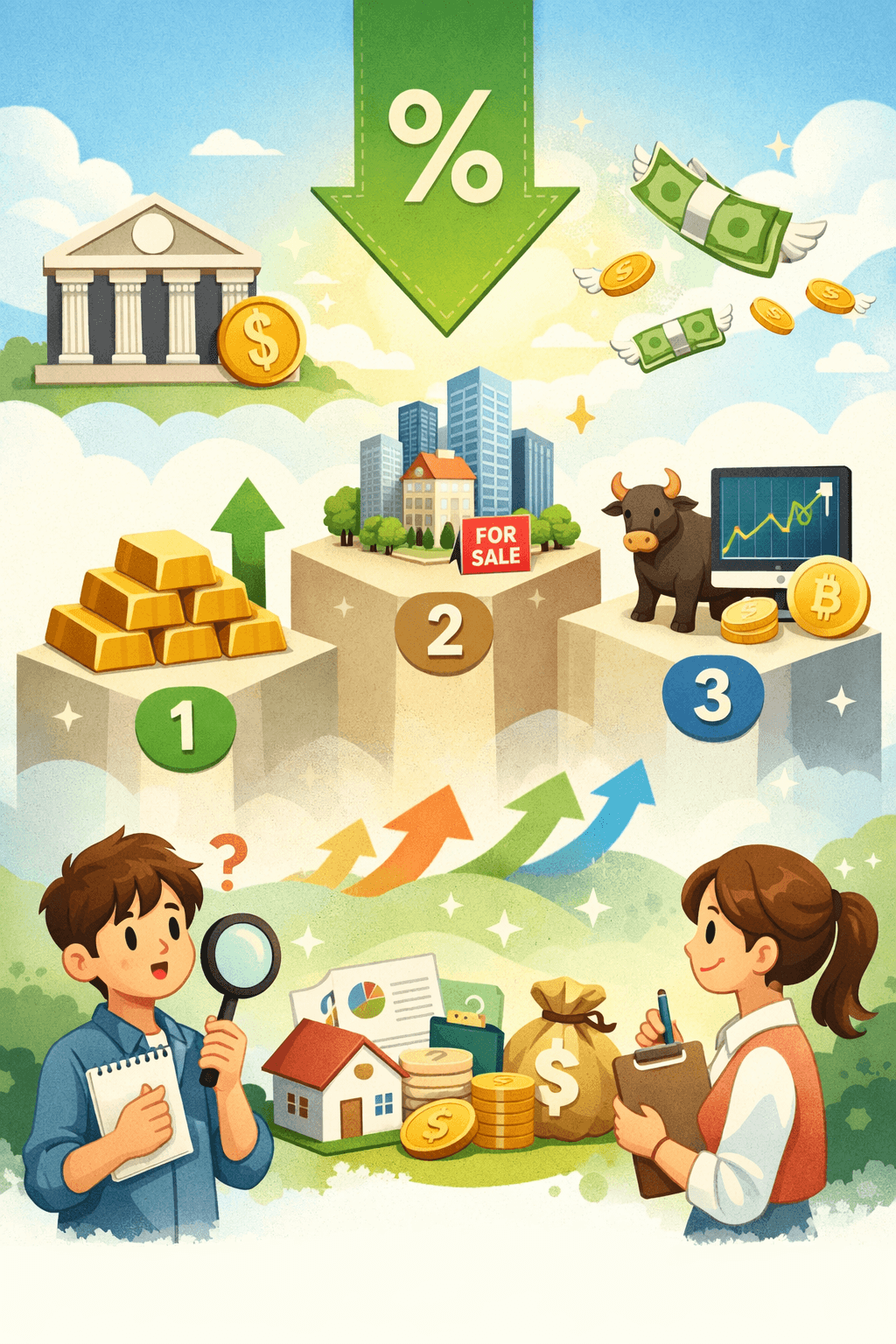
- When will interest rates start falling?
- And when they do,
which assets will rise first? - More importantly:
👉 What should you prepare now?
Rate cuts are not just about cheaper loans.
They mark the beginning of a shift in the entire asset market.
So what matters is not just that rates are falling,
but which assets move first.
1️⃣ Rate Cuts Signal the Start of Capital Movement
A rate cut is not just a policy decision.
It signals a shift in the flow of money.
At first, it may seem simple:
👉 “Borrowing becomes cheaper”
But in reality:
- capital starts moving into markets
- risk appetite increases
- asset prices begin to react
From experience:
Even when uncertainty is still high,
markets often start moving early.
👉 Stocks begin to rise
👉 liquidity gradually increases
That’s when it becomes clear:
👉 Interest rates are the cause, asset prices are the result
When rates fall:
- borrowing costs decrease
- investment capital increases
- demand for risk assets expands
👉 That’s why markets interpret rate cuts
as the beginning of a bull cycle.
👉 Related reading: Why Interest Rates Move All Assets — The Most Important Investment Factor
2️⃣ Stage 1: Bonds Move First
The first asset to react is:
👉 Bonds
When rates fall:
- existing bonds with higher yields become more valuable
So:
- long-term government bonds
- bond ETFs
react first.
This phase is often less visible,
but it marks the early shift in capital flow.
👉 Related reading: What Changes When Bond Yields Rise? The Starting Point of Asset Price Shifts and Portfolio Rebalancing
3️⃣ Stage 2: Growth Stocks and Tech Lead the Rally
Next comes:
👉 growth stocks (especially tech)
When rates fall:
- discount rates decrease
- future earnings become more valuable
So:
- Nasdaq
- tech-focused ETFs
respond quickly.
This phase is:
- fast-moving
- high-return
👉 It’s where the main market rally begins.
4️⃣ Stage 3: Real Estate and Physical Assets Follow
Once rates fall further:
👉 real estate starts reacting
Because:
- borrowing becomes cheaper
- demand increases
But real estate always reacts later.
Typical sequence:
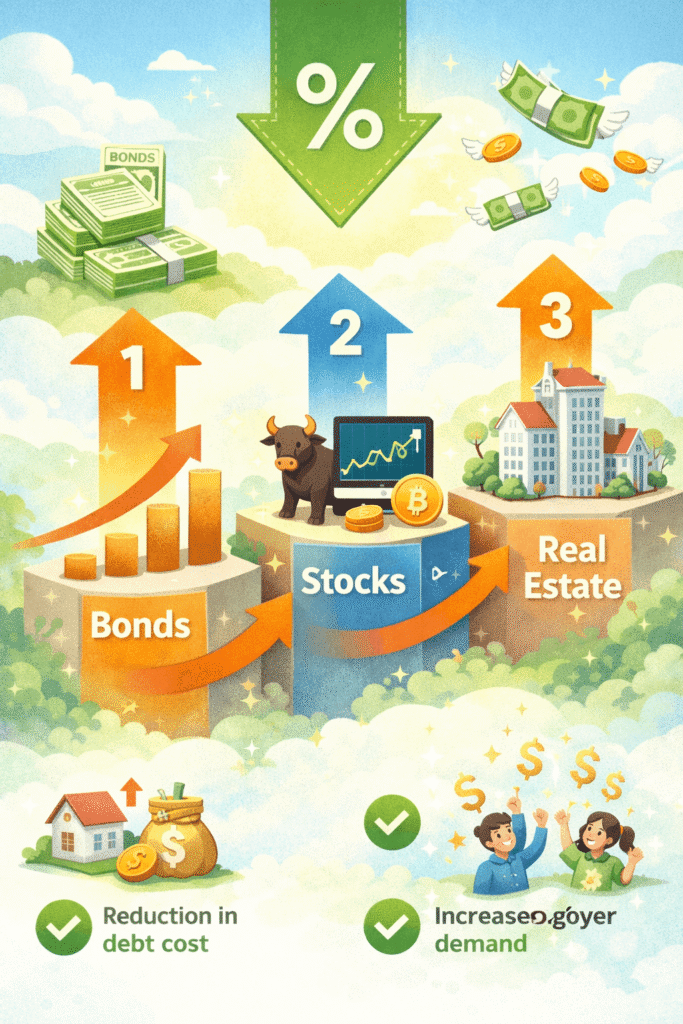
👉 Bonds → Stocks → Real Estate
👉 Related reading: Why Real Estate Falls When Interest Rates Rise — Leverage and the Mechanics of Market Decline
5️⃣ Stage 4: Broad Market Expansion
In the final stage:
👉 the rally spreads across the entire market
- small-cap stocks rise
- cyclical sectors outperform
- consumption recovers
But this phase comes after much of the upside is already priced in.
This is when:
- optimism is high
- positive news dominates
- “everyone is making money” sentiment spreads
At this point:
👉 risk increases
👉 returns become less attractive
👉 Related reading: Why the Stock Market Rallies Before the News — How Markets Price the Future
6️⃣ How Should Your Strategy Change?
Once you understand the sequence,
the strategy becomes clear.
Early stage (rate cuts begin)
- partial allocation to bonds
- increase exposure to growth stocks
Mid stage (rate cuts continue)
- focus on equities
- maintain diversification
Late stage (cycle matures)
- reduce risk
- rebalance portfolio
👉 The key is not:
“Where should I invest?”
👉 But:
“Which stage are we in?”
👉 Related reading: Why Portfolio Rebalancing Matters — When, How Much, and What to Adjust
📌 Final Thoughts
Rate cuts are not just policy changes.
They mark the beginning of a new market cycle.
But what matters is not just:
👉 that rates are falling
It is:
👉 how far the cycle has progressed
Markets always move in sequence:
- Bonds
- Stocks
- Real Estate
If you understand this flow:
👉 you won’t chase timing
👉 you will invest structurally
Understanding the sequence
is the key to smarter investing.
1 thought on “What to Invest in When Interest Rates Fall — Asset Order and Strategy Explained”
Comments are closed.