

Recently, the same questions keep coming up:
- Will interest rates finally go down?
- Or could they rise again?
- Is this the right time to invest?
With oil, exchange rates, and stock markets all reacting to interest rates,
understanding the direction of rates has become critical.
In this article, we break down
the three key signals you must watch
to understand where interest rates are heading.
1️⃣ Why Interest Rates Determine All Assets
Interest rates are not just a number.
They are:
- the price of money
- the benchmark for all assets
The flow of capital in the economy
is ultimately driven by interest rates.
- Rates ↑ → borrowing costs ↑ → asset prices ↓
- Rates ↓ → investment ↑ → asset prices ↑
When rates rise:
- companies reduce investment
- households reduce consumption
- liquidity in the market decreases
This puts pressure on:
- stocks
- real estate
When rates fall:
- borrowing becomes easier
- investment increases
- liquidity expands
This pushes asset prices higher.
👉 That’s why investors try to read interest rate direction first.
👉 Related reading: Why Interest Rates Move All Assets — The Most Important Investment Factor
2️⃣ Signal ① Inflation — The Core Driver of Rates
The most important factor behind interest rates
is inflation.
Recently, inflation is being influenced by:
- rising oil prices
- supply disruptions
- energy price volatility
When inflation rises:
👉 central banks cannot easily cut rates
When inflation stabilizes:
👉 rate cuts become possible
👉 Related reading: Oil at $150 — What Happens to Inflation, Interest Rates, and Markets?
3️⃣ Signal ② Economic Growth — The Downward Pressure
The second key factor is economic growth.
Growth determines the strength of the market.
When the economy slows:
- consumption declines
- corporate revenue weakens
- unemployment rises
This reduces overall money flow.
In this situation:
👉 central banks are pressured to lower rates
to stimulate the economy.
On the other hand:
- overheating economy
- rising inflation
👉 leads to rate hikes
So the economy is always balancing:
- Inflation ↑ → Rates ↑
- Growth ↓ → Rates ↓
The problem is:
👉 these two forces often move in opposite directions.
Example:
- weak growth + high inflation
This creates policy difficulty
and uncertainty in markets.
👉 Related reading: What Happens When Cash Allocation Increases? The Beginning of Portfolio Stability and Capital Flow Changes
4️⃣ Signal ③ Central Bank Stance — The Final Decision Maker
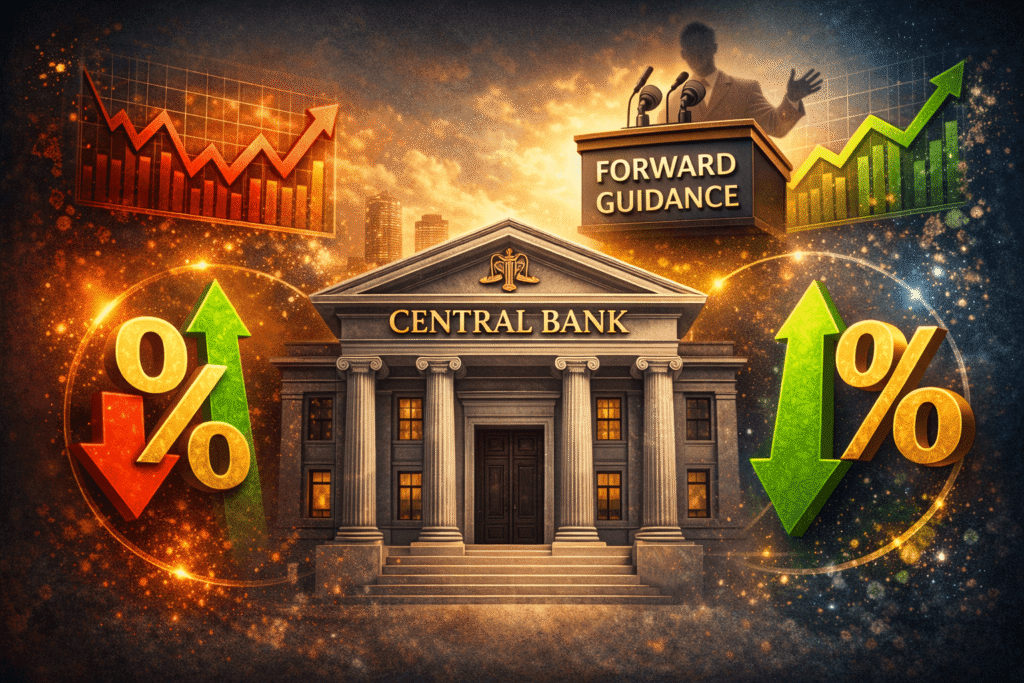
Ultimately, interest rates are decided by central banks.
So what matters is:
- how they act
- what they signal
Markets react more to:
👉 future guidance
than current rates.
👉 In many cases,
words move the market before actions.
👉 Related reading: Why the Stock Market Rallies Before the News — How Markets Price the Future
5️⃣ Where Are Interest Rates Heading Now?
The current environment is not clear-cut.
We see:
- persistent inflation uncertainty
- slowing economic signals
- volatile oil prices
This creates a mixed situation:
👉 reasons to raise rates
👉 and reasons to cut rates
at the same time.
So central banks face a dilemma:
- cut rates → inflation risk
- raise rates → growth risk
As a result, we are likely in:
👉 a “pause or gradual adjustment phase”
rather than aggressive moves.
Practical Insight
In uncertain rate environments:
👉 trying to “perfectly time” the market is risky
Instead:
👉 build a structure that can survive uncertainty
From real investing experience:
- even when rates don’t move sharply
- interest burden accumulates
- small disruptions in cash flow create pressure
So in this phase:
👉 maximizing returns is less important
👉 than stabilizing cash flow and reducing risk
👉 Related reading: Why Portfolio Rebalancing Matters — When, How Much, and What to Adjust
📌 Final Thoughts
Interest rates always move,
and their movement reshapes all asset markets.
The key is understanding
what drives those movements:
- Inflation
- Economic growth
- Central bank stance
If you understand these three,
👉 you can read the direction of interest rates.
In investing, success is not about
perfectly predicting the future.
👉 It is about building a structure
that can adapt to change.
1 thought on “Interest Rate Outlook 2026 — Will Rates Rise or Fall? 3 Key Signals Every Investor Must Watch”
Comments are closed.