

As tensions in the Middle East continue,
global oil prices are rising rapidly.
Recently, after seeing news about fuel price increases,
many people rushed to fill up their tanks.
This may seem like a simple action,
but it reflects how quickly market changes
are being felt in daily life.
Oil is no longer just a number —
it is directly affecting real-world decisions.
Markets are now discussing scenarios such as:
- closure of the Strait of Hormuz
- disruptions in Red Sea shipping
- oil reaching $150 per barrel
This is not just an oil price increase —
it is a potential global energy shock.
In this article, we explore
how a surge in oil prices could impact:
- inflation
- interest rates
- asset markets
1️⃣ This Is a Supply Shock, Not Just a Price Increase
The current oil rally is driven by supply disruption, not demand.
- The Strait of Hormuz carries ~20% of global oil supply
- War-related disruptions are already affecting flows
- Some scenarios suggest millions of barrels per day could be lost
As a result, oil prices have surged rapidly.
In recent months:
- oil has risen more than 50%
- reaching around $110–$120
Some projections suggest a move toward $150.
👉 Related reading: What Happens When Oil Prices Rise — Impact on Inflation, Interest Rates, and Stocks
2️⃣ Oil Surge → Inflation Reignites
The first impact of rising oil prices is inflation.
Why?
- higher transportation costs
- increased production costs
- rising raw material prices
These are passed directly to consumers.
So the structure becomes:
👉 Oil ↑ → Inflation ↑
This could reignite global inflation pressures.
👉 Related reading: Oil, Interest Rates, and Exchange Rates — 3 Key Forces That Drive the Market
3️⃣ Inflation → Delayed Rate Cuts (or Even Rate Hikes)
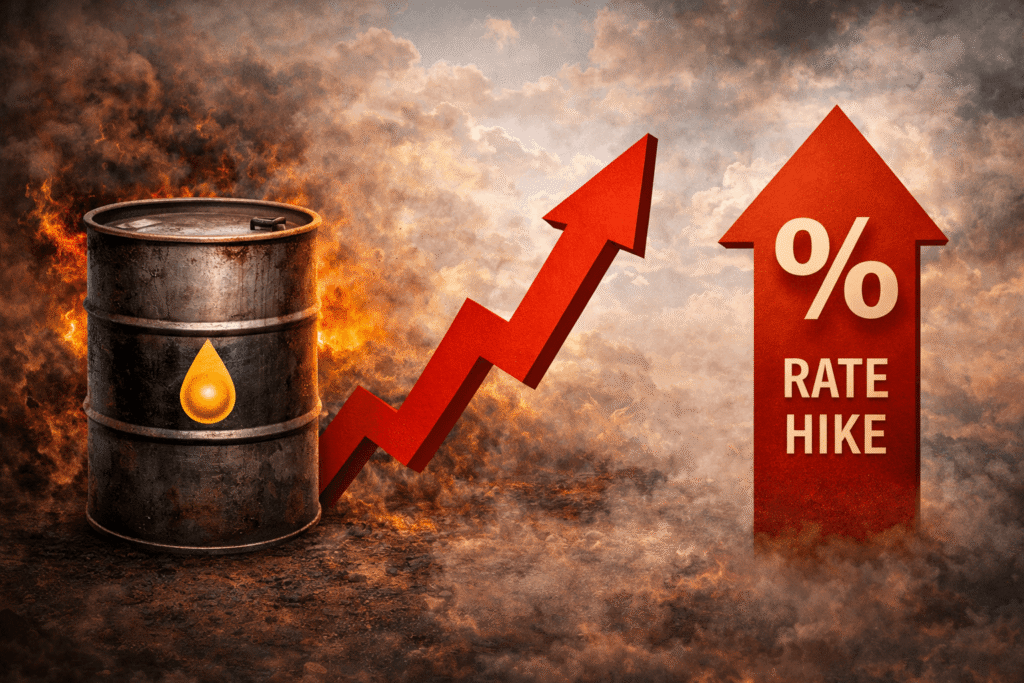
Central banks adjust interest rates
to control inflation.
But in this situation:
- inflation pressure is rising again
- rate cuts become difficult
Markets are now expecting:
- delayed rate cuts
- or even renewed rate hikes
So the structure becomes:
👉 Oil ↑ → Inflation ↑ → Rates stay high (or rise)
4️⃣ Market Impact — Broad Pressure Across Assets
This is where the real impact begins.
Stocks
- rising costs + higher rates
- growth stocks hit hardest
Real Estate
- higher borrowing costs
- reduced demand
Bonds
- rising yields → falling prices
Recently, markets have shown:
- stock declines
- rising bond yields
- increased volatility
Even traditional “safe assets”
are not fully stable in this environment.
👉 Related reading: What to Invest in When the Dollar Strengthens — Assets & ETF Strategy
5️⃣ Which Assets May Hold Up Better?
In this environment,
some assets tend to perform relatively better:
- energy-related assets
- commodities
- U.S. dollar
Why?
- Oil ↑ → energy company profits ↑
- Crisis → demand for USD increases
In recent market behavior:
- dollar strength
- commodity price increases
have already been observed.
📌 Final Thoughts
An oil price of $150
is not just a price change —
it represents a full energy shock scenario.
This leads to:
- rising inflation
- sustained interest rate pressure
- broad asset market stress
Similar to the 1970s,
this could impact the entire economy.
However, in investing:
You cannot predict crises —
but you can understand structure.
Markets always contain:
- exaggerated fear
- excessive optimism
That’s why in times like this:
👉 chasing trends is less important than
👉 understanding structure and managing risk
1 thought on “Oil at $150 — What Happens to Inflation, Interest Rates, and Markets?”
Comments are closed.