

With rising geopolitical risks and higher oil prices,
exchange rates have been increasing,
creating confusion for many people.
Some are reconsidering travel plans.
Others with family studying abroad
are feeling the pressure of a stronger dollar.
Questions naturally come up:
- Is the Korean won weakening?
- Should I invest overseas now?
- Should I buy dollars?
But exchange rates are not just numbers —
they reflect capital movement and asset flows.
During periods of dollar strength,
certain assets tend to benefit.
In this article, we break down:
- how exchange rates affect markets
- which assets benefit
- and practical ETF strategies
1️⃣ Rising Exchange Rates Signal Capital Movement
A rising exchange rate (stronger dollar)
usually occurs under conditions such as:
- rising interest rates
- increased global uncertainty
- preference for safe-haven assets
In these situations,
capital flows into dollar-denominated assets.
So exchange rates are not random —
they show where money is moving.
👉 Related reading: Oil, Interest Rates, and Exchange Rates — 3 Key Forces That Drive the Market
2️⃣ Assets That Benefit from a Strong Dollar
When the dollar strengthens,
four main asset groups tend to benefit:
① Dollar Assets
- direct exposure to USD
- benefit from currency appreciation
② Overseas Stocks / ETFs
- potential gains from both
→ asset growth + currency effect
③ Export-Oriented Companies
- higher profits when local currency weakens
④ Commodities
- often move alongside the dollar
- can act as inflation hedges
Understanding this structure
helps clarify investment direction.
👉 Related reading: Reducing Exchange Rate Risk Through Asset Structure
3️⃣ ETFs Make It Easier to Execute
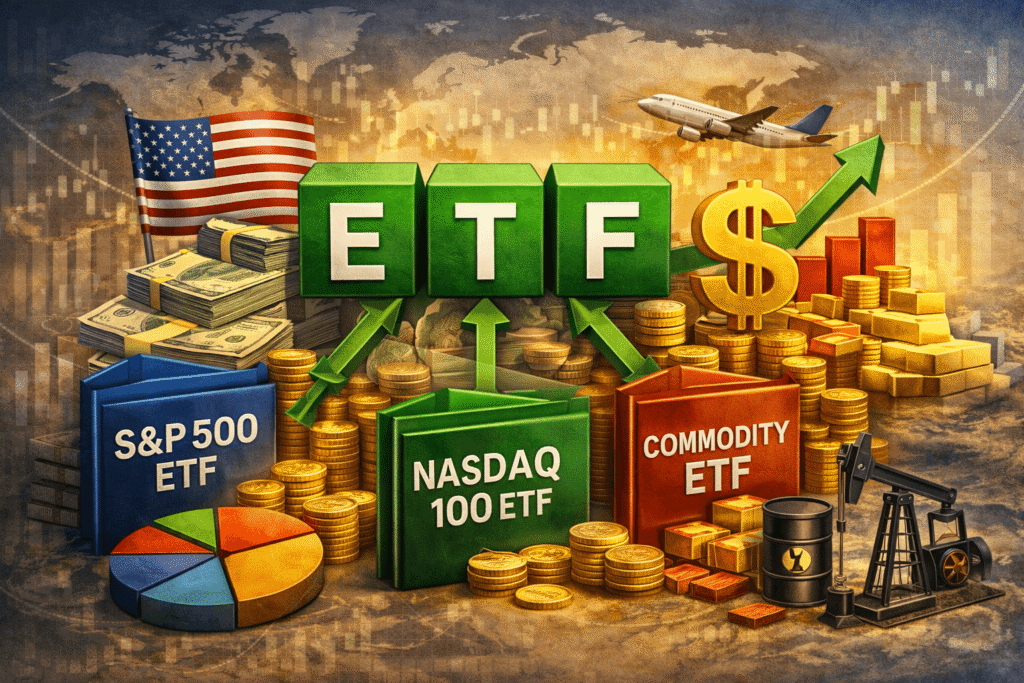
For individual investors,
ETFs are the most practical approach.
Key categories include:
- U.S. index ETFs (S&P 500, Nasdaq 100)
- dollar-related ETFs
- commodity ETFs
Advantages:
- diversification
- easier risk management
- accessibility
During dollar strength,
exposure to global ETFs often increases naturally.
👉 Related reading: S&P 500 vs Nasdaq 100 — Long-Term Investment Comparison with $100,000
4️⃣ Risks to Watch During Currency Rallies
A rising exchange rate is not always an opportunity.
Be cautious in situations like:
- already overextended price levels
- sharp short-term spikes
- excessive media hype
Entering at these points can lead to:
- losses if the currency reverses
- simultaneous asset price corrections
👉 The key is not to chase the currency move.
5️⃣ A Practical Portfolio Strategy
A realistic approach during dollar strength:
- review global asset exposure
- hold some USD-based assets
- invest through diversified ETFs
- maintain rebalancing discipline
You cannot predict exchange rates,
but you can control your portfolio structure.
📌 Final Thoughts
A rising exchange rate is not just economic news —
it is a signal of how capital is moving.
During dollar strength:
- capital shifts globally
- certain assets benefit
- portfolio structures evolve
The key is not predicting currency moves,
but understanding the flow.
In investing:
- structure matters more than timing
- balance matters more than selection
Maintaining core principles
is the most stable long-term strategy.
1 thought on “What to Invest in When the Dollar Strengthens — Assets & ETF Strategy”
Comments are closed.