

One of the most common words people hear in investing is “compound interest.”
Most people know that compound growth is important.
But in reality, many still struggle to understand:
- when the effect actually becomes powerful
- how large the difference becomes over time
- why long-term investors emphasize time so much
In this article,
we’ll look at when compound interest truly becomes noticeable
and how assets change as investment time gets longer.
1️⃣ Compound Interest Accelerates as Time Passes
Compound interest is not simply about making profits.
It is a structure where:
👉 returns begin generating additional returns.
At first, growth feels slow.
But over time,
the speed of growth gradually accelerates.
You can think of it like this:
- First 5 years → slow growth
- Next 5 years → faster growth
- After that → much faster acceleration
That’s why compound growth often feels invisible in the beginning.
👉 The effect becomes noticeable only after enough time has passed.
2️⃣ A 20-Year Investment Is Not Just Double a 10-Year Investment
Let’s compare using the same assumptions.
Investment Conditions
- Initial investment: ₩10 million
- Annual return: 7%
✔ 10-year investment
→ approximately ₩20 million
✔ 20-year investment
→ approximately ₩39 million
👉 Difference: approximately ₩19 million
The important point is this:
The investment period only doubled.
But the final asset value became much larger than a simple 2x increase.
That is the power of compound interest.
👉 The longer time passes,
👉 the faster accumulated returns begin growing.
👉 Related reading: How to Start Investing in Global ETFs — A Beginner Portfolio Guide
3️⃣ When Does Compound Interest Become Noticeable?
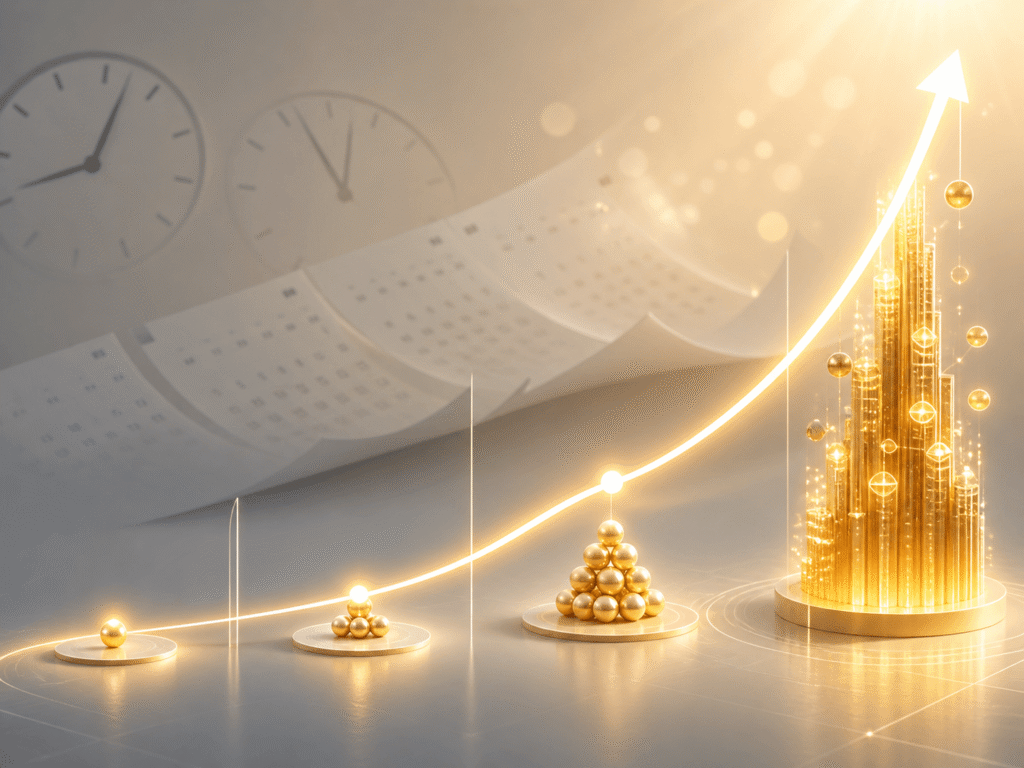
Compound interest starts working immediately.
But the point where people actually begin to feel the effect is different.
Generally speaking:
- 1–3 years → barely noticeable
- Around 5 years → slight progress becomes visible
- Around 10 years → clearly noticeable
- 15+ years → strong acceleration becomes visible
That’s why many people initially think:
“My investments aren’t growing much.”
But after around 10 years,
the experience often changes dramatically.
4️⃣ The Difference Becomes Much Larger With Monthly Investing
Compound growth becomes even stronger
when investing consistently every month.
For example:
Monthly Investment Example
- Monthly investment: ₩500,000
- Annual return: 7%
✔ 10 years
→ approximately ₩86 million
✔ 20 years
→ approximately ₩260 million
👉 Difference: approximately ₩180 million
The key point is important.
The difference was not created by investment skill.
👉 It was created by time.
That’s why compound growth is not simply an advantage for wealthy people.
👉 It rewards people who stay invested consistently for a long period of time.
👉 Related reading: The Cost of Delaying Investing — How Compound Interest Changes Your Wealth Over Time
5️⃣ Compound Interest Rewards Early Starters
The best way to maximize compound growth is simple:
👉 start early
👉 and stay invested for a long time.
Many people delay investing because they want:
- more knowledge
- better timing
- more confidence
But during that process,
they lose the most important factor in investing:
👉 time.
That’s why compound growth depends less on perfect returns
and more on:
- starting earlier
- maintaining consistency
- staying invested long enough
👉 Related reading: Dollar-Cost Averaging vs Lump-Sum Investing — Returns vs Risk Explained
📌 Final Thoughts
Compound interest feels extremely slow at first.
When I first started investing,
many people talked about “the power of compound interest.”
But honestly,
I could not truly feel it in the beginning.
At that stage,
it simply sounded like a theory.
That’s why many investors stop too early.
They expect dramatic results quickly,
but compound growth works differently.
👉 It rewards patience before it rewards speed.
Eventually, however,
a point arrives where asset growth becomes much more visible.
And from that moment,
the structure of wealth accumulation starts changing rapidly.
That’s why investment success is not determined only by high returns.
👉 It is also determined by how long you stay invested.
In the end,
compound interest is less about chasing fast profits
and more about allowing time to work for you.
1 thought on “When Does Compound Interest Really Start Working? — A Simple Comparison of 10-Year vs 20-Year Investing”
Comments are closed.